
SeedVR2 vs Magnific: Which AI Upscaler Restores an Image Instead of Rewriting It?

264 image pairs, 13 evaluators, 792 blind judgments. SeedVR2 took detail recovery 86% to 2% and naturalness 82% to 2%. The one scale where Magnific closes the gap is also the one our evaluators could not agree on.
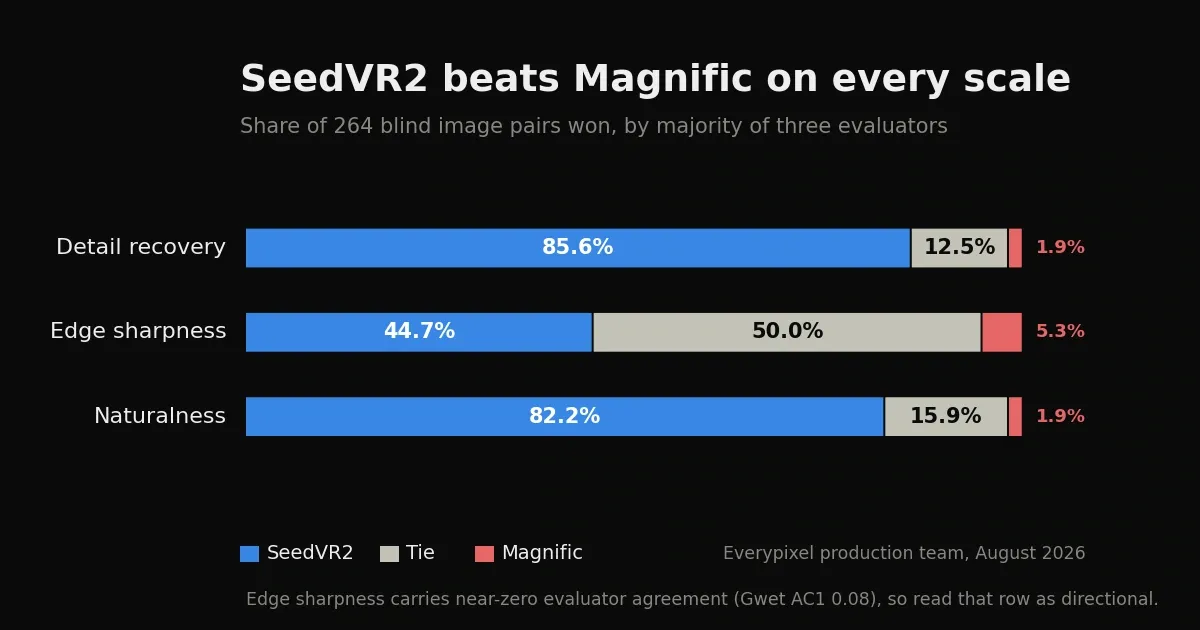
Tested as of August 2026. 264 image pairs, 13 human evaluators, 792 blind judgments.
SeedVR2 is the better upscaler for real photographs, faces, crowds, and images containing text. In our blind paired test of 264 image pairs, August 2026, evaluators picked SeedVR2 for detail recovery in 86% of pairs against 2% for Magnific, and for naturalness in 82% against 2%. Magnific stays competitive only on edge sharpness, and it buys that sharpness by adding detail that was never in the source.
Why we tested SeedVR2 against Magnific
Every upscaler faces the same trade-off: recover what the sensor recorded, or synthesize something plausible that looks sharper on a thumbnail. Marketing copy for both categories uses the same word, "enhance," for two opposite operations.
We ran the comparison because our own pipelines push tens of thousands of images through upscaling before publication. When a model invents a face in a crowd or garbles a shop sign, that image is unusable, and no amount of perceived sharpness compensates.
This is the third run of the same harness, and the three results now form a usable scale.
| Opponent | Published | P(SeedVR2 better) | 95% CI |
|---|---|---|---|
| FLUX.2 klein 9B | June 2026 | 0.80 | not published |
| Magnific | August 2026 | 0.78 | 0.76–0.80 |
| Topaz Wonder 3 | August 2026 | 0.55 | 0.53–0.58 |
Topaz Wonder 3 is what a close result looks like: 54 to 60% of pairs ended in a tie, agreement sat at AC1 0.06 to 0.12, and the conclusion was directional rather than verified. Magnific lands 23 points away from that, in the same territory as FLUX.2 klein 9B. Read the rest of this article against that anchor.
What SeedVR2 and Magnific actually are
SeedVR2 is a one-step diffusion restoration model from ByteDance Seed, published as "SeedVR2: One-Step Video Restoration via Diffusion Adversarial Post-Training" (arXiv:2506.05301, submitted June 5, 2025, revised January 28, 2026) and accepted at ICLR 2026. Weights ship in 3B and 7B checkpoints under the Apache 2.0 license, and the model handles single images as well as video.
SeedVR2
ByteDance Seed
Magnific is the upscaler built by Javi Lopez and Emilio Nicolas, acquired by Freepik in May 2024, and now the brand name for the entire Freepik platform. Its API reference documents two separate upscaling endpoints: Upscaler Creative, "AI upscaling with detail enhancement," and Upscaler Precision, "faithful upscaling" (Magnific API documentation, accessed August 2026).
Magnific
Magnific, formerly Freepik
Methodology
The test ran as a blind paired comparison: 264 source images, each upscaled by both models, shown side by side with model identity hidden and left/right position randomized. Every pair was judged independently by three people, producing 792 human judgments from 13 evaluators across three roles: QA testers, art directors, and distribution reviewers (Everypixel production team, August 2026).
Sources: 132 real photographs and 132 AI-generated images, split across six categories: crowds and complex scenes, faces, materials and textures, nature, text and signage, urban scenes. The synthetic half comes from the same production stack covered in our GPT Image 2.0 benchmark.
Scales: three separate votes per pair. Detail recovery, edge sharpness, naturalness. Each vote is A, B, or "equal."
Agreement: reported as Gwet's AC1. Fleiss' kappa collapses toward zero when judgments are heavily skewed toward one side even when real agreement is high, which is the kappa paradox, so it is not informative here.
Win probability: Bradley-Terry model strength with 95% confidence intervals from a cluster bootstrap over pairs.
Shared assets: the source images and the SeedVR2 outputs are the same set used in the FLUX.2 klein 9B benchmark, per the asset paths in `data/pairs_raw.csv`, which is what makes the overall probabilities comparable across the series.
Secondary signal: 528 additional judgments from two AI judges, Gemini 3.1 Pro and Gemini 3.5 Flash, recorded separately and never mixed into the human results.
SeedVR2 vs Magnific: results by scale
| Scale | SeedVR2 wins | Magnific wins | Tie | P(SeedVR2 better) | 95% CI | Agreement (Gwet AC1) |
|---|---|---|---|---|---|---|
| Detail recovery | 85.6% | 1.9% | 12.5% | 0.836 | 0.815–0.856 | 0.50 |
| Edge sharpness | 44.7% | 5.3% | 50.0% | 0.671 | 0.648–0.695 | 0.08 |
| Naturalness | 82.2% | 1.9% | 15.9% | 0.833 | 0.812–0.854 | 0.49 |
| Combined | — | — | — | 0.780 | 0.759–0.799 | — |
Percentages are the share of pairs where the majority of three evaluators chose that model.
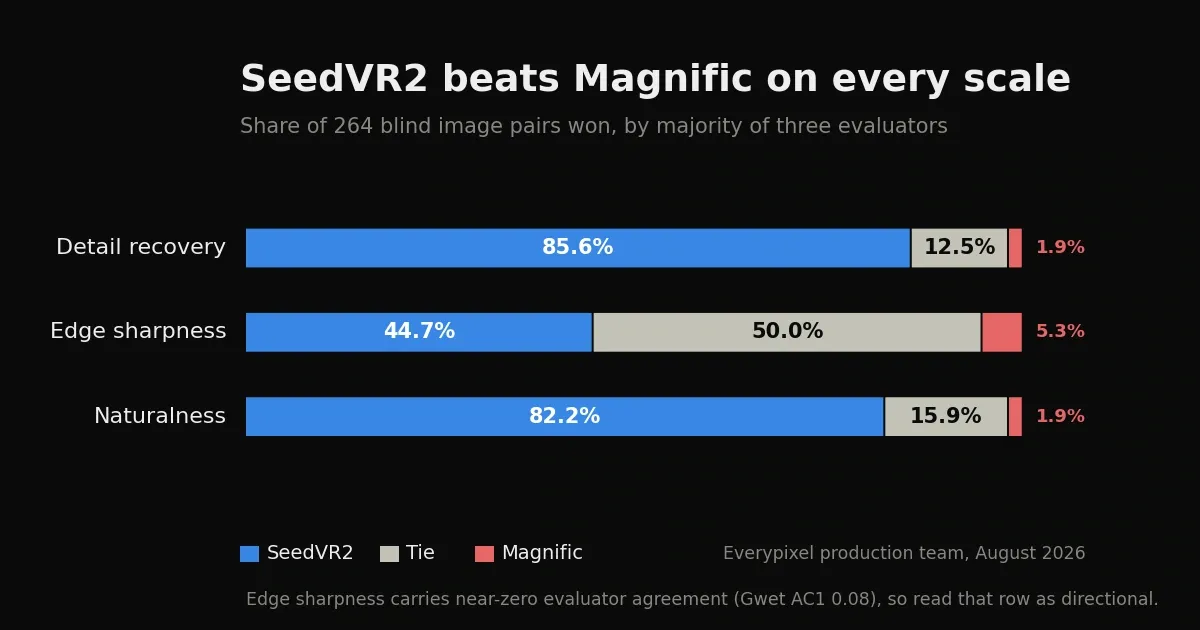
On a randomly selected image pair, SeedVR2 is the better upscaler with 78% probability, 95% CI 76–80% (Everypixel production team, August 2026). The interval sits far from the 50% parity line, so the direction of the result is not in question.
Which upscaler wins by image type
| Category | Detail recovery | Edge sharpness | Naturalness |
|---|---|---|---|
| Crowds, complex scenes | 89 / 0 / 11 | 55 / 5 / 41 | 91 / 0 / 9 |
| Faces | 93 / 0 / 7 | 43 / 2 / 55 | 86 / 0 / 14 |
| Materials and textures | 73 / 0 / 27 | 39 / 2 / 59 | 71 / 0 / 30 |
| Nature | 86 / 7 / 7 | 36 / 11 / 52 | 73 / 7 / 20 |
| Text and signage | 86 / 2 / 11 | 43 / 7 / 50 | 80 / 2 / 18 |
| Urban scenes | 86 / 2 / 11 | 52 / 5 / 43 | 93 / 2 / 5 |
- SeedVR2
- Magnific
SeedVR2 leads in all six source categories on all three scales, with no exception (Everypixel production team, August 2026). Its widest margin is on faces, where it takes 93% of pairs on detail recovery and Magnific takes none. That is a margin over Magnific specifically, not a general claim about SeedVR2 and faces: in the Topaz Wonder 3 test, Topaz reversed the ranking on facial naturalness, winning 52% of pairs against SeedVR2's 14%. Its narrowest is on materials and textures, where 27% of pairs end in a tie on detail, though Magnific still wins 0% of them.
The result holds equally for real photographs and AI-generated sources. Detail recovery goes 83.3% to SeedVR2 on real photos and 87.9% on AI generations, with Magnific at 2.3% and 1.5% respectively (Everypixel production team, August 2026). Whatever separates the two models is not an artifact of synthetic training data.
What evaluators said about each upscaler
Twenty-two written summaries came back from 12 people. Opinions converged more tightly than in any previous round of this benchmark.
SeedVR2, praised for: following the source instead of adding to it, handling faces and text carefully, holding texture and surface structure, preserving the original color and temperature, and applying moderate sharpening without halos. One QA tester also noted that it is free.
> "A general-purpose upscaler that fits most tasks where you need to improve the original without distorting it." — QA tester
> "It treats faces and text delicately, and the picture reads as more natural overall." — art director
SeedVR2, criticized for: making skin look more wrinkled than the original, which one art director described as "lizard skin" on tight face crops. Occasional blown highlights near frame edges. Some fine text still gets distorted. Occasional softness.
Magnific, praised for: adding microtexture such as skin pores, fur, and fabric nap, which makes an image feel alive. Lifting sharpness on wide shots and on images that are already high resolution. Working acceptably on graphics, abstract scenes, and landscapes.
Magnific, criticized for: drawing in object edges, highlights, and speckles that were not in the source. Distorting faces into plastic-looking skin, and turning small faces in a crowd into mush. Failing to recognize text. Shifting color and temperature, and oversaturating.
> "It tries to 'improve' the picture by adding details and highlights that were not in the source." — art director
> "A mediocre model, worth using mostly on artistic images without fine detail or complex texture." — QA tester
Evaluator criticism of Magnific clusters on a single mechanism: the model generates plausible detail rather than recovering recorded detail (Everypixel production team, August 2026). Every specific failure reported, including invented edges, plastic skin, unreadable signage, and dissolved faces in crowds, is a downstream consequence of that behavior.
That behavior is documented, not incidental. Magnific's own API reference describes its Creative upscaling path as "prompt-guided enhancement that can introduce or infer new detail" (Magnific API documentation, accessed August 2026). Our panel worked blind, without access to that description, and named the same mechanism as its central complaint.
The criticism of SeedVR2 has an external match too. ByteDance states on the SeedVR2 model card that the models "tend to overly generate details on inputs with very light degradations," producing "oversharpened results occasionally," and that they are "sometimes not robust to heavy degradations" (ByteDance-Seed, SeedVR2 model card, accessed August 2026). The "lizard skin" our art directors saw on tight face crops is a limitation the authors had already written down.
Where the result gets complicated: edge sharpness
Edge sharpness is the scale where the numbers look weakest, and it is also the scale you should trust least.
On edge sharpness, agreement between evaluators is effectively zero: Gwet's AC1 = 0.08 with 50% of pairs ending in a tie (Everypixel production team, August 2026). The 67% win probability on this scale should be read as an orientation, not as a finding. The other two scales hold AC1 near 0.5, and the overall verdict rests on those.
The mechanism behind that disagreement is legible. Magnific does add sharpness, and it adds artifacts along with it. Each evaluator weighs "sharper, but with garbage" differently, so the votes scatter. This is the strongest argument a defender of Magnific could make, and it is worth taking seriously: on a scale that measures only local contrast at edges, Magnific is genuinely closer to competitive than the headline numbers suggest. It does not rescue the verdict. Sharpness that arrives with invented content is not a win condition for any production workflow that has to ship the result.
Agreement is lower across roles than within them. Cross-role AC1 runs 0.38 / 0.07 / 0.26 on the three scales against 0.50 / 0.08 / 0.49 for the full group (Everypixel production team, August 2026). Art directors and distribution reviewers call ties more often, QA testers pick a winner more often, and distribution reviewers credit Magnific with detail wins in 16.9% of their individual judgments against 1.6% for QA testers. The direction is identical for all three roles, so the ranking does not depend on who is looking.
Creative or Precision: the Magnific mode we did not test
Magnific ships two upscaling paths, and this test covers one of them. The Creative endpoint adds detail by design. The Precision endpoint is documented as "faithful upscaling," aimed at exactly the restoration work where our evaluators found Magnific weakest (Magnific API documentation, accessed August 2026).
The evaluator reports describe behavior consistent with Magnific's detail-adding upscaling path, and the data package does not record which endpoint or slider settings were used (Everypixel production team, August 2026). Read this result as a verdict on creative upscaling applied to restoration work, not on every upscaling mode Magnific offers.
A model built to invent detail losing to a model built to recover it is a narrower finding than the headline numbers suggest. It is still the finding that matters for anyone who reaches for the default Magnific upscaler on a photograph, which is what most people do. The Precision comparison is the obvious next test, and we will run it.
Can AI judges replace human evaluators?
The AI judges agree with the human majority where humans agree with each other, and break down where they do not. Gemini 3.1 Pro matched the human majority in 80% of pairs on detail recovery and 76% on naturalness, but only 41% on edge sharpness (Everypixel production team, August 2026). Across 528 AI judgments, ties were almost never used, 3 by one judge and 15 by the other, so on the scale where half of human pairs read as "equal," the AI judge is forced to invent a preference.
Use AI judges to confirm a direction that human data already establishes. Do not use them to replace people, and do not use them at all on a scale where people disagree with each other.
Which AI upscaler should you use?
Default to SeedVR2 over Magnific
For people, crowds, text and signage, real photographs, catalog and product imagery, and any bulk upscaling pass before publication, it is the correct choice as of August 2026. It preserves the original, and its weights are Apache 2.0, which removes the usual reason to tolerate a worse result.
Portraits are the one carve-out, and Magnific is not the reason
SeedVR2 takes 93% of face pairs against Magnific here, so within this comparison there is nothing to weigh. Across the series, though, faces are the only place any tool has beaten SeedVR2: Topaz Wonder 3 won facial naturalness 52% to 14% in our August 2026 test. If close-up faces are the whole job rather than one category inside a batch, that is the comparison to read, not this one.
Reach for Magnific only when invention is the assignment
Graphics, illustration, abstract scenes, landscapes without people or fine text, and images that are already high resolution and need local contrast rather than recovered detail. Expect to tune settings per image rather than run it as a batch step.
Do not use Magnific on low-resolution or blurred sources as well as crowd scenes with small faces, portraits, fine fabric texture and repeating patterns, or anything with legible text.
SeedVR2 vs Magnific pricing
SeedVR2 is Apache 2.0, so the weights are free to download and run on your own hardware. ByteDance's repository notes that one H100-80G handles 100x720x1280 video, and quantized FP8 and INT8 builds of both checkpoints are available for smaller cards through ComfyUI. As a managed endpoint, Replicate lists a community SeedVR2 deployment at "approximately $0.12 to run, or 8 runs per $1" on H100 hardware (Replicate, accessed August 2026).
Magnific lists no free tier. Plans run EUR 12 per month for Premium billed annually against EUR 16 month to month, with 240K credits per year; EUR 27 for Premium+ annually against EUR 36 month to month, with 600K credits; and EUR 172.50 for Pro annually against EUR 230 month to month, with 4M credits.
Credits stay valid for a year with no monthly reset (Magnific pricing page, accessed August 2026). Cost per image depends on the credit price of an upscale call, which that page does not publish. One caution that applies to SeedVR2 as well: on tight face crops with visible skin texture, check the output. The model can read wrinkles as detail to recover and deepen them past the original.
FAQ
Frequently asked questions
Which AI upscaler is better, SeedVR2 or Magnific?
SeedVR2, in our blind test of 264 image pairs from August 2026. It wins detail recovery in 86% of pairs against 2%, and naturalness in 82% against 2%. Overall probability that SeedVR2 is better on a random pair is 78%, 95% CI 76 to 80%.
Is Magnific better than SeedVR2 for anything?
Edge sharpness on wide shots, graphics, abstract art, and landscapes without people or text. Even there, half of the pairs on the sharpness scale ended in a tie, and evaluator agreement on that scale is near zero, so treat the margin as directional.
Does SeedVR2 work on AI-generated images as well as photographs?
Yes. Detail recovery favors SeedVR2 in 88% of AI-generated pairs and 83% of real-photo pairs, so the gap does not depend on source type.
Why does Magnific make faces look plastic?
It synthesizes texture rather than recovering it. On skin, that reads as uniform pores and smoothed structure. On small faces in a crowd, evaluators reported the features dissolving entirely.
Can SeedVR2 handle text and signage?
Better than Magnific, which evaluators said does not recognize text at all. SeedVR2 takes 86% of text and signage pairs on detail recovery. It still distorts some very fine text, so proof any image where the type has to be readable.
Is SeedVR2 free?
The weights are released under Apache 2.0 and can be self-hosted at no license cost, so you pay only for compute. Magnific is subscription-based, starting at EUR 12 per month on annual billing with no free tier as of August 2026.
Did this test use Magnific's Creative or Precision mode?
The behavior our evaluators described matches the detail-adding Creative path. The endpoint is not recorded in the data package, and Magnific's Precision mode, documented as faithful upscaling, has not been benchmarked against SeedVR2 yet.
What we test next
The interesting question is no longer which of these two wins. It is whether a faithful-mode commercial upscaler can beat an open-weights restoration model on the work that actually pays, meaning catalog images, crowds, and signage. Magnific's Precision endpoint is the next benchmark in this series. Three benchmarks in, the only tool that has pushed SeedVR2 to a genuine draw is Topaz Wonder 3, and it did that by winning on faces. If an Apache 2.0 model keeps taking the rest, the argument for paying per upscale gets harder to make each round.
About Everypixel
Everypixel builds AI tools for visual production. We run these benchmarks on the same pipelines we ship, which is why the test set is production imagery rather than an academic dataset, and why the evaluators are the people who would have to use the output. Previous and upcoming model tests are published at research.everypixel.com, and the tools themselves live at workroom.everypixel.com.
Sources
- SeedVR2: One-Step Video Restoration via Diffusion Adversarial Post-Training arxiv.org/abs/2506.05301
- SeedVR repository github.com/ByteDance-Seed/SeedVR
- SeedVR2-3B model card huggingface.co/ByteDance-Seed/SeedVR2-3B
- SeedVR2 image and video upscaling docs.comfy.org/tutorials/utility/seedvr2
- SeedVR2 managed endpoint replicate.com/zsxkib/seedvr2
- Upscaler Creative and Upscaler Precision docs.magnific.com
- Pricing plans magnific.com/pricing
All external sources accessed August 2026. Internal benchmark data is listed under Data below.
Cite this article
<blockquote cite="https://research.everypixel.com/seedvr2-vs-magnific/"> <p>264 image pairs, 13 evaluators, 792 blind judgments. SeedVR2 took detail recovery 86% to 2% and naturalness 82% to 2%. The one scale where Magnific closes the gap is also the one our evaluators could not agree on.</p> <footer>— <a href="https://research.everypixel.com/seedvr2-vs-magnific/">SeedVR2 vs Magnific: Which AI Upscaler Restores an Image Instead of Rewriting It?</a>, Everypixel Research, August 2026</footer> </blockquote>
Everypixel Research. (2026). SeedVR2 vs Magnific: Which AI Upscaler Restores an Image Instead of Rewriting It?. research.everypixel.com. https://research.everypixel.com/seedvr2-vs-magnific/